
How to Clean a Mattress: A Simple Step by Step Guide
You wash your sheets every week. The mattress under them has probably never been cleaned at all. Most people do not think about it until a spill, a stale smell, or a week of stuffy mornings makes them look closer. Here is how to clean a mattress at home, what the popular advice gets wrong, and how to tell when the job is bigger than a box of baking soda.
What is actually in your mattress
You spend about a third of your life on it. In that time it collects dead skin, sweat, body oil, and the fine dust that drifts down through your sheets.
Most articles will also tell you it is crawling with dust mites. That is less true here than in most of the country. Dust mites need moisture in the air to live. They do not survive well once the air drops below about 50 percent humidity, and they die off when it stays drier than that for a long stretch. A heated house along the Wasatch Front in January often sits in the 20s or low 30s. Our air is hard on mites.
That does not let you off the hook. Dry air kills mites, but it does not carry anything out of the bed. Mite debris, skin, and oil all stay right where they settled until something removes them.
How to deep clean a mattress, step by step
Give yourself a morning. The mattress needs time to dry before the sheets go back on.
What to have ready
- A vacuum with the upholstery attachment
- Baking soda, more than you think you need
- An enzyme cleaner, the kind sold for pet stains
- Two or three clean white cloths
- A spray bottle of cool water
- A fan
The steps
- Strip the bed. Wash the sheets, pillowcases, and mattress protector in hot water.
- Vacuum the top, then the sides, then the seams. The seams hold the most and get skipped the most.
- Treat any stains now, before the baking soda goes on. The method is below.
- Sprinkle baking soda across the whole surface.
- Let it sit. Thirty minutes does something. A few hours does more.
- Vacuum it all back off in slow, overlapping passes.
- If your mattress can be flipped, do the other side too.
- Point a fan at the bed, or open a window, until it feels completely dry.
How to clean mattress stains
Four rules cover almost every spot. Blot, never scrub. Spray the cleaner onto the cloth instead of onto the mattress. Work from the outside of the stain toward the middle so you do not spread it. Finish by blotting with a barely damp cloth, then a dry one.
- Sweat and body oil, the yellow rings: enzyme cleaner on a cloth, dab, then blot dry.
- Blood: cold water only. Warm water sets it and you will not get it back.
- Coffee, juice, and food: cool water with one drop of dish soap on the cloth.
- Urine: enzyme cleaner, and be patient with it. The same rules we use for pet accidents apply here.
One rule matters more than all of that: never soak a mattress. Foam and padding hold water like a sponge, and unlike a towel you cannot wring them out. A mattress that gets too wet can stay damp inside for days, and damp padding grows mildew. You will smell it long before you see it, and by then it is inside the thing you sleep on.
What baking soda can and cannot do
Baking soda is worth doing. It pulls moisture out of the top layer and takes some odor with it. What it will not do is reach the soil pressed into the padding, and it does not lift body oil at all.
So if your mattress is basically fine and needs freshening, baking soda and a careful vacuum will get you there. If the smell fades for a week and then comes back, the source is deeper than the surface, and no amount of powder on top will find it.
When it is worth paying someone
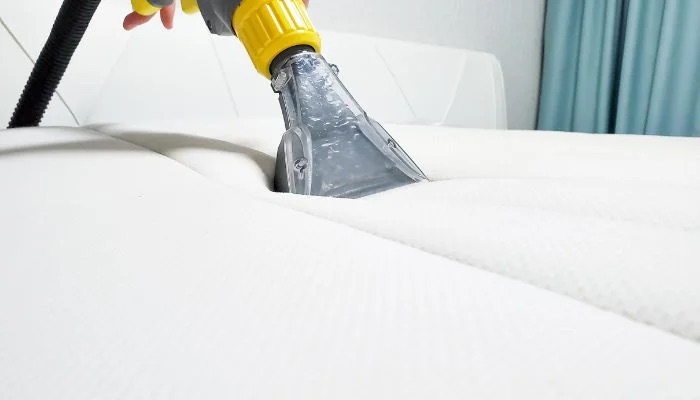
The difference is not a stronger cleaner. It is putting water in and pulling it back out in the same motion. Hot water extraction sprays and vacuums at once, so moisture never sits in the mattress the way it does when you clean by hand. That is the part you cannot copy at home.
Our process starts with a look at the mattress, then spot treatment, then deep agitation to loosen what is trapped in the upper layers, then hot water extraction with a rinse that leaves no residue. Everything we use is safe for kids and pets once dry, and a mattress cleaned in the morning is usually ready for fresh sheets by evening. Once a year keeps buildup in check for most homes. The full process is on our mattress cleaning page, with rates on our pricing page.
Between cleanings, small habits do most of the work. Use a washable mattress protector, wash bedding weekly in hot water, vacuum the mattress every time you change the sheets, and pull the covers back for a few minutes before you make the bed.
We have been cleaning mattresses in Utah County and Salt Lake County homes since 1985. Book a cleaning online or call (801) 400-2770 for a firm price before we start.
